ART
EXHIBITIONS
EXHIBITIONS
CHROME DREAMS OF ELSEWHERE
Motion, Memory, and the Imagined Life
MARC ABASOLO
MARC ABASOLO
MARC ABASOLO
|
|
|
PAINTINGS
PAINTINGS
PAINTINGS
|
|
|
18 JULY - 8 AUG 2026
18 JULY - 8 AUG 2026
18 JULY - 8 AUG 2026
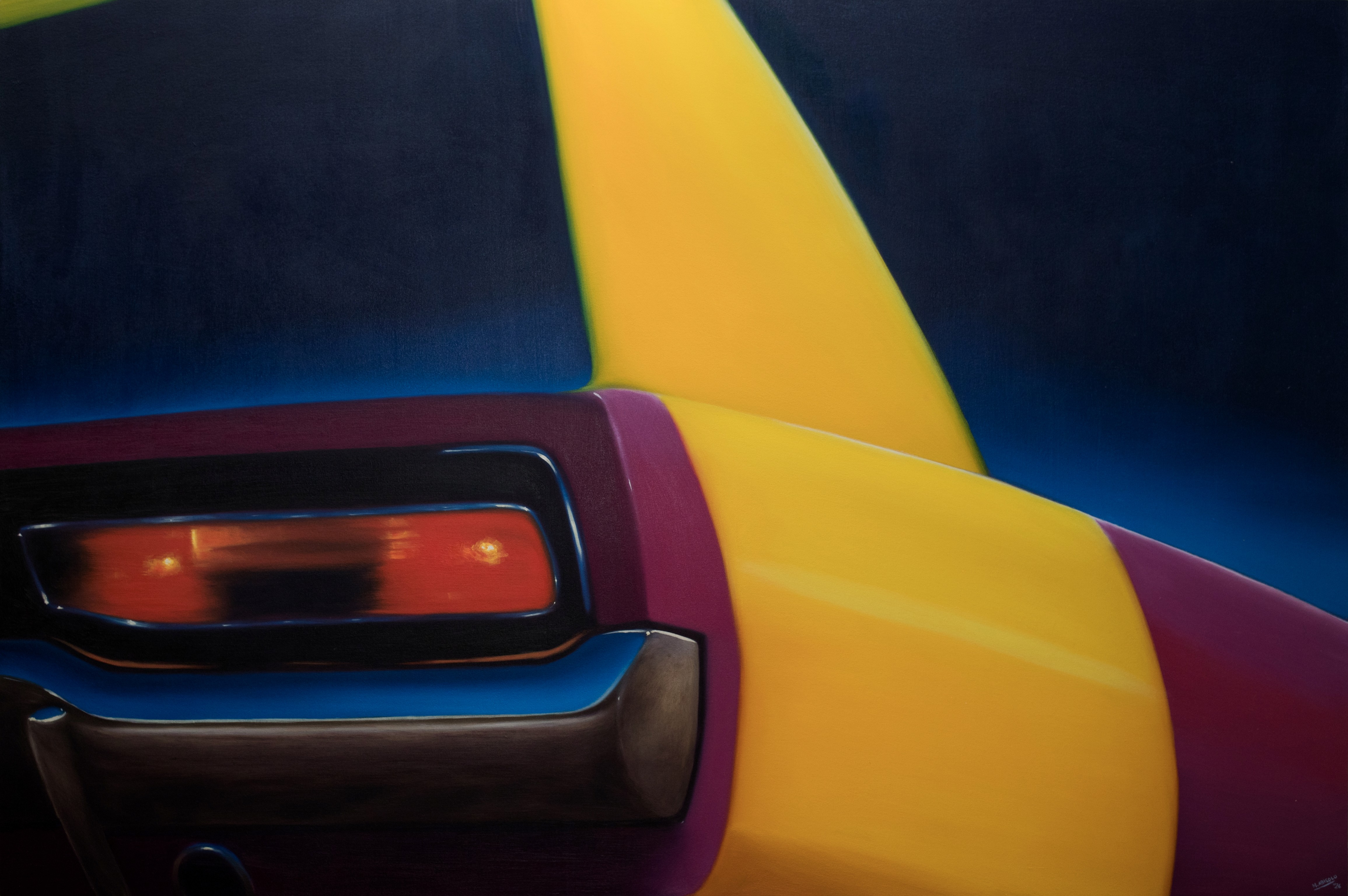
Rocksteady, Oil on Canvas, 6 X 4 ft.
Marc Abasolo’s first cars were drawn because he could not take them home.
His mother brought him to toy stores, where he studied the miniature automobiles behind glass. His practical parents rarely bought them. Back home, paper and whatever pens or pencils were lying around became his substitute collection.
The disappointment survived childhood and developed expensive tastes.
Marc Abasolo’s first cars were drawn because he could not take them home.
His mother brought him to toy stores, where he studied the miniature automobiles behind glass. His practical parents rarely bought them. Back home, paper and whatever pens or pencils were lying around became his substitute collection.
The disappointment survived childhood and developed expensive tastes.
Marc Abasolo’s first cars were drawn because he could not take them home.
His mother brought him to toy stores, where he studied the miniature automobiles behind glass. His practical parents rarely bought them. Back home, paper and whatever pens or pencils were lying around became his substitute collection.
The disappointment survived childhood and developed expensive tastes.
The exhibition, Chrome Dreams of Elsewhere (Motion, Memory, and the Imagined Life), opening on July 18 at Spruce Gallery in Ortigas Center, begins in that formative distance between the desired object and the life imagined around it.
Marc still paints from that first absence. The cars have grown larger, rarer, and considerably more expensive. The longing has accumulated ambition, memory, faith, pleasure, anxiety, and the recurring discovery that the summit of one mountain often turns out to be the parking area for the next.
Before the automobile became machinery to him, it was possibility. Drawing offered an early form of possession. He kept through attention what he could not carry out of the shop, studying and reconstructing the remembered object until it became his in another form.
That remains the emotional engine of the work.
The exhibition, Chrome Dreams of Elsewhere (Motion, Memory, and the Imagined Life), opening on July 18 at Spruce Gallery in Ortigas Center, begins in that formative distance between the desired object and the life imagined around it.
Marc still paints from that first absence. The cars have grown larger, rarer, and considerably more expensive. The longing has accumulated ambition, memory, faith, pleasure, anxiety, and the recurring discovery that the summit of one mountain often turns out to be the parking area for the next.
Before the automobile became machinery to him, it was possibility. Drawing offered an early form of possession. He kept through attention what he could not carry out of the shop, studying and reconstructing the remembered object until it became his in another form.
That remains the emotional engine of the work.

Champagne Powder, Oil on Canvas, 3 X 4 ft.
Chrome Dreams of Elsewhere names the territory Marc has travelled since childhood. Chrome belongs to the engineered object: polished metal, commodity, glamour, status. Dreams carry everything placed inside it: the remembered toy, the projected future, the person waiting to be met farther along the road. Elsewhere is the destination that shifts whenever he draws near.
Marc begins with recognizable automobiles, then allows memory, instinct, music, and invention to interfere. A vehicle slips underwater. Flowers overtake a hood. Chrome and bodywork are cropped toward abstraction. A pink car hurtles into an optical delirium of neon excess, synth-pop euphoria, MTV graphics, speculative optimism, and very committed shoulder pads, suggesting speed, desire, or what happens when magenta is given executive power.
The collection unfolds through three movements, each a different gear within the same imagination.
Chrome Dreams of Elsewhere names the territory Marc has travelled since childhood. Chrome belongs to the engineered object: polished metal, commodity, glamour, status. Dreams carry everything placed inside it: the remembered toy, the projected future, the person waiting to be met farther along the road. Elsewhere is the destination that shifts whenever he draws near.
Marc begins with recognizable automobiles, then allows memory, instinct, music, and invention to interfere. A vehicle slips underwater. Flowers overtake a hood. Chrome and bodywork are cropped toward abstraction. A pink car hurtles into an optical delirium of neon excess, synth-pop euphoria, MTV graphics, speculative optimism, and very committed shoulder pads, suggesting speed, desire, or what happens when magenta is given executive power.
The collection unfolds through three movements, each a different gear within the same imagination.

Arrival, Oil on Canvas, 4 X 4 ft.
THE MACHINE UNDER THE SKIN
The expressive works reveal Marc at his most exposed. Lines remain visible, space compresses, and automotive forms push into stairs, interiors, railings, and layered structures. Physical pressure remains on the surface. The brushwork stays exposed, and the image retains the strain of being built.
The Arrival is central. Its staircase pulls the eye upward through a compressed architectural field. A wheel-like form hovers near the ascent. Marks accumulate, cross, and redirect one another with the urgency of a thought still being worked out.
Ambition becomes physical here. Progress involves effort, interruption, recalculation, and the decision to take another step. The automobile has moved inward, becoming psychological infrastructure.
Marc speaks often of moving forward while recognizing the need to stop before ambition begins eating the furniture. His expressive works carry that rhythm. Their exposed construction brings the strain beneath automotive polish into view, along with the scaffolding required for any convincing arrival.
Giacomo Balla’s Speeding Automobile of 1912 dissolved the car into curves and directional force, giving visual form to movement itself. Marc inherits that propulsion and redirects it toward a life. Speed becomes resolve, longing, and faith in a road whose conclusion remains invisible.
Marc describes pressing the accelerator as an act of belief: in the journey, in God, in oneself, and in those travelling alongside. His career began during the pandemic with sketches, online lessons, inexpensive paints, stubborn self-instruction, and a fiancée who encouraged him to try because there was little to lose. He sold early drawings, accepted commissions, increased his scale, and met collectors through referrals, Instagram, chance encounters, and the occasional luxury boutique. Art history has produced stranger business plans.

Bloom, Oil on Canvas, 4 X 4 ft.
OUT OF ITS ELEMENT
In the painterly-surreal works, the car leaves the road and enters another element. Sunset clouds fill the windscreen. Flowers spread across metal. A blue vehicle descends beneath water with the composure of a whale, or perhaps a luxury object discovering that brand equity has limited influence on marine life.
These paintings give stillness its own momentum.
The windscreen is one of modernity’s stranger frames. It opens the landscape while keeping the traveller behind glass. The world arrives as a moving image, turning the vehicle into a small cinema with upholstery and occasional arguments over navigation.
In Marc’s sunset painting, driving becomes contemplation. The image grew from a moment in Hawaii when he stopped above the clouds and allowed gratitude to catch up with ambition. The car becomes a viewing chamber and the road a spiritual space.
The submerged work carries a darker calm. Water slows the machine and muffles the engine. A form associated with mastery and velocity appears vulnerable, creaturely, almost surrendered. The image hovers somewhere among serenity, peril, surrender, and whatever may come after submersion, mercifully without forming a committee to settle the official interpretation.
OUT OF ITS ELEMENT
In the painterly-surreal works, the car leaves the road and enters another element. Sunset clouds fill the windscreen. Flowers spread across metal. A blue vehicle descends beneath water with the composure of a whale, or perhaps a luxury object discovering that brand equity has limited influence on marine life.
These paintings give stillness its own momentum.
The windscreen is one of modernity’s stranger frames. It opens the landscape while keeping the traveller behind glass. The world arrives as a moving image, turning the vehicle into a small cinema with upholstery and occasional arguments over navigation.
In Marc’s sunset painting, driving becomes contemplation. The image grew from a moment in Hawaii when he stopped above the clouds and allowed gratitude to catch up with ambition. The car becomes a viewing chamber and the road a spiritual space.
The submerged work carries a darker calm. Water slows the machine and muffles the engine. A form associated with mastery and velocity appears vulnerable, creaturely, almost surrendered. The image hovers somewhere among serenity, peril, surrender, and whatever may come after submersion, mercifully without forming a committee to settle the official interpretation.
OUT OF ITS ELEMENT
In the painterly-surreal works, the car leaves the road and enters another element. Sunset clouds fill the windscreen. Flowers spread across metal. A blue vehicle descends beneath water with the composure of a whale, or perhaps a luxury object discovering that brand equity has limited influence on marine life.
These paintings give stillness its own momentum.
The windscreen is one of modernity’s stranger frames. It opens the landscape while keeping the traveller behind glass. The world arrives as a moving image, turning the vehicle into a small cinema with upholstery and occasional arguments over navigation.
In Marc’s sunset painting, driving becomes contemplation. The image grew from a moment in Hawaii when he stopped above the clouds and allowed gratitude to catch up with ambition. The car becomes a viewing chamber and the road a spiritual space.
The submerged work carries a darker calm. Water slows the machine and muffles the engine. A form associated with mastery and velocity appears vulnerable, creaturely, almost surrendered. The image hovers somewhere among serenity, peril, surrender, and whatever may come after submersion, mercifully without forming a committee to settle the official interpretation.

Beluga, Oil on Canvas, 6 X 4 ft.
J. G. Ballard understood how deeply the automobile had entered the modern psyche. In Crash, cars become entangled with bodies, sexuality, celebrity, media, technology, and violence. Marc’s world carries more wonder, though his submerged and distorted vehicles retain an awareness that desire often travels with danger in the passenger seat.
His cars frequently appear alive. Headlights become eyes, grilles become mouths, and horns turn machinery into animal form. We already call cars muscular, elegant, aggressive, responsive, temperamental, and occasionally possessed. Marc simply allows them to stop pretending.
J. G. Ballard understood how deeply the automobile had entered the modern psyche. In Crash, cars become entangled with bodies, sexuality, celebrity, media, technology, and violence. Marc’s world carries more wonder, though his submerged and distorted vehicles retain an awareness that desire often travels with danger in the passenger seat.
His cars frequently appear alive. Headlights become eyes, grilles become mouths, and horns turn machinery into animal form. We already call cars muscular, elegant, aggressive, responsive, temperamental, and occasionally possessed. Marc simply allows them to stop pretending.
DESIRE, ENLARGED
The hyper-Pop works return the automobile to the bright theatre of public desire. Polka dots, flowers, racing imagery, optical patterns, saturated fields, and severe crops draw from advertising, fashion, cinema, toys, and graphic culture.
Richard Hamilton broke the car into chrome, curves, machinery, and manufactured seduction. James Rosenquist pushed automotive imagery to billboard scale, making the familiar sensual and strange. Andy Warhol’s commissioned Cars series brought Mercedes-Benz into Pop, where an acclaimed automobile and an acclaimed artist could meet as two exceptionally well-managed brands.
DESIRE, ENLARGED
The hyper-Pop works return the automobile to the bright theatre of public desire. Polka dots, flowers, racing imagery, optical patterns, saturated fields, and severe crops draw from advertising, fashion, cinema, toys, and graphic culture.
Richard Hamilton broke the car into chrome, curves, machinery, and manufactured seduction. James Rosenquist pushed automotive imagery to billboard scale, making the familiar sensual and strange. Andy Warhol’s commissioned Cars series brought Mercedes-Benz into Pop, where an acclaimed automobile and an acclaimed artist could meet as two exceptionally well-managed brands.
DESIRE, ENLARGED
The hyper-Pop works return the automobile to the bright theatre of public desire. Polka dots, flowers, racing imagery, optical patterns, saturated fields, and severe crops draw from advertising, fashion, cinema, toys, and graphic culture.
Richard Hamilton broke the car into chrome, curves, machinery, and manufactured seduction. James Rosenquist pushed automotive imagery to billboard scale, making the familiar sensual and strange. Andy Warhol’s commissioned Cars series brought Mercedes-Benz into Pop, where an acclaimed automobile and an acclaimed artist could meet as two exceptionally well-managed brands.

Speedbug, Oil on Canvas, 4 X 4 ft.

Flower Power, Oil on Canvas, 3 X 4 ft.
Marc shares their attraction to crop, scale, surface, and recognition. A lamp, fin, grille, or curve allows memory to rebuild the entire vehicle. His relationship with the commodity begins in biography. Hamilton studied the machinery that produces desire; Warhol sent the icon back into circulation. Marc brings us to the child who wanted the object before he understood the economic system keeping it behind glass.
The hyper-Pop paintings preserve the thrill of the toy-store window. They enlarge it, repaint it, and finally bring it home.
Marc’s hyper-Pop instinct also belongs to a culture that has long treated the vehicle as a moving surface for invention. The Philippine jeepney emerged from military surplus and was remade through chrome, hand-painted lettering, religious imagery, movie stars, basketball heroes, family names, jokes, and a national reluctance to leave any available surface emotionally unemployed. Marc has not painted the jeepney here, though its permission lingers nearby: machinery may carry personality, memory, aspiration, and an entire private cosmology.
Manila supplies the darker joke. The automobile promises freedom in a city famous for withholding movement. A jeepney, delivery van, family sedan, and Lamborghini may possess radically different biographies, yet gridlock gathers them into the same republic of brake lights. Wealth improves the leather, air-conditioning, and quality of despair. It cannot always purchase the next four meters. Traffic becomes one of the city’s last imperfect democracies, where envy, irritation, curiosity, and delight idle side by side.
The paintings also arrive during a volatile period in automotive culture. Jaguar’s rebrand and pink, fashion-led Type 00 and Ferrari’s electric Luce, developed with Jony Ive and Marc Newson, both disturbed the visual memories attached to legendary marques. Their divided reception revealed how personally the public guards the shapes through which it learned to desire a car.
The intensity of these reactions reveals the emotional authority of the automobile. Beyond the trademarks, factories, and tooling, another kind of ownership gathers around the car: the public’s emotional claim upon its form.
A grille, silhouette, engine note, or color becomes attached to films, family journeys, bedroom posters, first salaries, vanished relatives, adolescent fantasies, and futures once pictured in extravagant detail. Changing the object can feel like revising someone’s memory without asking.
Marc works inside this charged territory with freedoms unavailable to a corporate designer protecting several billion dollars and a board already reaching for antacids. He can drown the car, flower it, give it horns, or propel it into optical hysteria. Recognition survives because the emotional cue remains.
Across its expressive, surreal, and hyper-Pop registers, Chrome Dreams of Elsewhere follows the automobile through several lives: internal mechanism, dream vessel, cultural icon, and gleaming container for the future self.
Marc shares their attraction to crop, scale, surface, and recognition. A lamp, fin, grille, or curve allows memory to rebuild the entire vehicle. His relationship with the commodity begins in biography. Hamilton studied the machinery that produces desire; Warhol sent the icon back into circulation. Marc brings us to the child who wanted the object before he understood the economic system keeping it behind glass.
The hyper-Pop paintings preserve the thrill of the toy-store window. They enlarge it, repaint it, and finally bring it home.
Marc’s hyper-Pop instinct also belongs to a culture that has long treated the vehicle as a moving surface for invention. The Philippine jeepney emerged from military surplus and was remade through chrome, hand-painted lettering, religious imagery, movie stars, basketball heroes, family names, jokes, and a national reluctance to leave any available surface emotionally unemployed. Marc has not painted the jeepney here, though its permission lingers nearby: machinery may carry personality, memory, aspiration, and an entire private cosmology.
Manila supplies the darker joke. The automobile promises freedom in a city famous for withholding movement. A jeepney, delivery van, family sedan, and Lamborghini may possess radically different biographies, yet gridlock gathers them into the same republic of brake lights. Wealth improves the leather, air-conditioning, and quality of despair. It cannot always purchase the next four meters. Traffic becomes one of the city’s last imperfect democracies, where envy, irritation, curiosity, and delight idle side by side.
The paintings also arrive during a volatile period in automotive culture. Jaguar’s rebrand and pink, fashion-led Type 00 and Ferrari’s electric Luce, developed with Jony Ive and Marc Newson, both disturbed the visual memories attached to legendary marques. Their divided reception revealed how personally the public guards the shapes through which it learned to desire a car.
The intensity of these reactions reveals the emotional authority of the automobile. Beyond the trademarks, factories, and tooling, another kind of ownership gathers around the car: the public’s emotional claim upon its form.
A grille, silhouette, engine note, or color becomes attached to films, family journeys, bedroom posters, first salaries, vanished relatives, adolescent fantasies, and futures once pictured in extravagant detail. Changing the object can feel like revising someone’s memory without asking.
Marc works inside this charged territory with freedoms unavailable to a corporate designer protecting several billion dollars and a board already reaching for antacids. He can drown the car, flower it, give it horns, or propel it into optical hysteria. Recognition survives because the emotional cue remains.
Across its expressive, surreal, and hyper-Pop registers, Chrome Dreams of Elsewhere follows the automobile through several lives: internal mechanism, dream vessel, cultural icon, and gleaming container for the future self.

Moment, Oil on Canvas, 6ft x 4 ft

Catalyst, Oil on Canvas, 3 X 4 ft.
ARRIVAL COMES WITH ANOTHER KEY
The automobile promises movement through space and movement through life. It can signify independence, prosperity, escape, taste, status, and arrival. Sociologist John Urry’s idea of automobility describes the larger system through which cars shape cities, consumption, identity, and daily freedom. Marc brings that system back to one person’s interior life.
For him, the desired vehicle changes as one achievement reveals another ambition. Consumer culture is wonderfully efficient at ensuring that every arrival includes directions to somewhere else.
The paintings trace a curious exchange between art and commerce. Metal, engineering, and labor become a desirable object; advertising releases its image into the world. Marc receives that image, removes its utility, and returns it as painting. The commodity passes through memory, ready now to enter another collection and another private life.
The circle would be suspiciously perfect were it not so human.
Robert Bechtle’s ’61 Pontiac places the automobile inside family memory, social aspiration, and an already inhabited American life. Marc begins closer to the distance between circumstance and possibility. Bechtle paints possession remembered. Marc often paints possession imagined.
This collection marks Marc’s movement from rendering the automotive memories of commissioners toward claiming the car as his own visual language. Across expressive rawness, surreal suspension, and hyper-Pop voltage, the vehicle becomes memory, creature, landscape, aspiration, and self-portrait.
Marc once drew cars because ownership belonged elsewhere.
The first absence remains inside the work, providing its engine. Faith keeps the road open beyond what can presently be seen. He has travelled farther without leaving either behind.
In Chrome Dreams of Elsewhere, the road, very sensibly, has declined to end.
ARRIVAL COMES WITH ANOTHER KEY
The automobile promises movement through space and movement through life. It can signify independence, prosperity, escape, taste, status, and arrival. Sociologist John Urry’s idea of automobility describes the larger system through which cars shape cities, consumption, identity, and daily freedom. Marc brings that system back to one person’s interior life.
For him, the desired vehicle changes as one achievement reveals another ambition. Consumer culture is wonderfully efficient at ensuring that every arrival includes directions to somewhere else.
The paintings trace a curious exchange between art and commerce. Metal, engineering, and labor become a desirable object; advertising releases its image into the world. Marc receives that image, removes its utility, and returns it as painting. The commodity passes through memory, ready now to enter another collection and another private life.
The circle would be suspiciously perfect were it not so human.
Robert Bechtle’s ’61 Pontiac places the automobile inside family memory, social aspiration, and an already inhabited American life. Marc begins closer to the distance between circumstance and possibility. Bechtle paints possession remembered. Marc often paints possession imagined.
This collection marks Marc’s movement from rendering the automotive memories of commissioners toward claiming the car as his own visual language. Across expressive rawness, surreal suspension, and hyper-Pop voltage, the vehicle becomes memory, creature, landscape, aspiration, and self-portrait.
Marc once drew cars because ownership belonged elsewhere.
The first absence remains inside the work, providing its engine. Faith keeps the road open beyond what can presently be seen. He has travelled farther without leaving either behind.
In Chrome Dreams of Elsewhere, the road, very sensibly, has declined to end.

Cloud 9, Oil on Canvas, 6 X 4 ft.
ABOUT THE ARTIST
ABOUT THE ARTIST

Marc Abasolo (b. 1997, Manila) is a contemporary Filipino artist whose work explores the automobile as a vessel for ambition, memory, faith, desire, and the imagined life.
Largely self-taught, he began drawing cars in childhood and developed his professional practice during the pandemic. Through referrals and private introductions, Abasolo has built a discerning collector base that includes prominent business leaders and private patrons in the Philippines and abroad. His commissions often portray rare automobiles, luxury cars, and important watch collections, with works acquired at the upper end of the local private-commission market.
Abasolo attended Civil Engineering at De La Salle University for nearly four years before transferring to Enderun Colleges, where he pursued Business Administration. He later took Marketing for the Art World at Sotheby’s Institute of Art in New York. He founded LAPASSION ART in 2020 and also serves as Vice President for Sales at MJ & Sons Enterprises Incorporated.
Chrome Dreams of Elsewhere is his first solo exhibition.
STAY IN THE LOOP
Sign up for early access to upcoming collections, events, and exhibitions.
STAY IN THE LOOP
Sign up for early access to upcoming collections, events, and exhibitions.
STAY IN THE LOOP
Sign up for early access to upcoming collections, events, and exhibitions.